Essential Oils for Energy: The Natural Way to Feel More Alive Every Day
There's a specific kind of tiredness that sleep doesn't fix, the kind that shows up mid-morning even after a full night of rest, or that drags you down around 3pm no matter how much coffee you've already had. It's something a lot of us quietly live with, and most of us reach for caffeine as a reflex, without ever questioning whether there's a gentler, more sustainable option.
That's where essential oils come in. Not as a miracle cure, and not as a replacement for the basics — sleep, water, movement — but as a meaningful, sensory tool that can genuinely shift your mental state in a matter of moments. Scent is one of the fastest pathways to the brain. It bypasses the thinking mind and goes straight to the limbic system, the part of you that governs emotion, alertness, and mood. That's not marketing language — it's how our neurochemistry actually works.
We built Frangipani around this idea: that everyday rituals, when done with intention and quality ingredients, have real power. This guide walks you through the best essential oils for energy, how they work, and how to actually use them in a way that fits real life.
Key Takeaways
Several essential oils have well-researched stimulating and mood-lifting properties that can naturally support energy and mental alertness.
Peppermint, lemongrass, bergamot, litsea cubeba, and eucalyptus are among the most effective essential oils for combating fatigue.
Inhalation (diffusing or direct breathing) works fastest for energy-related benefits, while roll-ons offer portable, on-the-go application.
Blending two or more complementary oils often creates a stronger, more rounded effect than using any single oil alone.
Quality matters — pure, plant-derived oils without synthetic additives perform very differently from synthetic fragrances.
Essential oils work best as part of a broader self-care approach, not as a standalone fix for chronic fatigue.
Why Essential Oils Can Help With Energy
Before we get into specific oils, it helps to understand why scent affects energy levels at all.
When you inhale an aroma, odor molecules travel through the nasal cavity and stimulate olfactory receptors. Those receptors send signals directly to the limbic system — specifically the amygdala and hippocampus — which are deeply involved in emotional regulation, memory, and arousal. Certain aromatic compounds have been shown to stimulate the release of neurotransmitters like serotonin and norepinephrine, both of which play a role in wakefulness, mood, and motivation. As Yale Scientific notes, smell is the only sense whose primary processing pathway directly involves the amygdala and limbic system — which is precisely why scent can shift your emotional state before your conscious mind has caught up.
A peer-reviewed study published in PMC looked specifically at how peppermint influences physiological parameters and exercise performance, finding significant improvements across reaction time, grip strength, and respiratory function. Essential oils aren't drugs, and their effects are subtle — but subtle doesn't mean insignificant, especially when you're building daily rituals around them.
There's also a behavioral dimension worth noting. A consistent morning ritual that involves intentional scent — opening a diffuser, rolling something onto your wrists before you sit down to work — trains your nervous system to associate that scent with a focused, alert state. Over time, the ritual itself becomes part of the shift.
The Best Essential Oils for Energy
Peppermint
Peppermint is probably the most studied essential oil for alertness and physical energy, and for good reason. Its primary active compound, menthol, has a cooling, stimulating effect on both the skin and the respiratory system. Inhaling peppermint has been associated with improved exercise performance, reduced perceived effort during physical activity, and sharper mental focus.
It's also incredibly fast-acting. A few deep breaths over a bottle of peppermint oil, or a quick inhale from your wrists after applying a peppermint roll-on, can cut through mental fog in under a minute. A study published in PubMed found that peppermint aroma enhanced memory and increased alertness in healthy participants compared to a no-aroma control. It's the closest thing to a natural "reset button" in aromatherapy.
Frangipani's Peppermint Essential Oil is 100% plant-derived, free from synthetic additives, and works equally well in a diffuser or diluted into a carrier oil for topical use.
Lemongrass
Lemongrass has a bright, herbaceous, slightly citrusy scent that feels almost like a burst of fresh air. It's widely used in traditional practices across Southeast Asia — not just for its aroma, but for its revitalizing and mood-clearing properties.
From an aromatherapy standpoint, lemongrass is associated with mental clarity, anxiety reduction, and an overall uplifting effect. It's particularly good for the kind of sluggishness that comes from stress or overstimulation — when your mind is tired from noise rather than from physical exertion.
Frangipani's Lemongrass Essential Oil captures that clean, alive quality really beautifully. It's one of those oils that smells like it's doing something even before you think about the benefits.
Litsea Cubeba (May Chang)
This one is worth knowing if you don't already. Litsea cubeba — sometimes called May Chang — comes from a small fruit grown across Southeast Asia and has a scent profile that's genuinely distinctive: sharp, citrusy, slightly floral, warm rather than cold. It's more complex than a straightforward lemon or lime, and more interesting.
It shares many properties with other citrus oils in terms of mood elevation and mental stimulation, but it has a depth to it that makes it feel grounding as well as energizing. In Thai traditional practices, it's used to promote alertness and positive feelings — and that cultural context is part of what inspired our founder to build Frangipani's signature blends around it.
The Litsea Cubeba Essential Oil is one of our most distinctive single oils, and it's a wonderful base for blending.
Bergamot
Bergamot is a citrus fruit grown primarily in southern Italy, and its essential oil has a more nuanced, refined scent than most citrus oils — floral and slightly tea-like alongside the brightness. It's the oil that gives Earl Grey tea its characteristic flavor.
What makes bergamot particularly well-suited for an energy context is its dual action: it's both uplifting and calming, which sounds contradictory but makes practical sense. If your fatigue is stress-driven — if you're exhausted because you're anxious or overwhelmed — bergamot addresses both the emotional heaviness and the low energy at once. A randomized crossover clinical trial published on PubMed found that bergamot essential oil inhalation measurably reduced negative emotions and fatigue scores while increasing parasympathetic nervous system activity in healthy participants.
Frangipani's Bergamot Essential Oil is cold-pressed and beautifully clean — no synthetic additives, no fillers.
Eucalyptus
Eucalyptus is immediately recognizable — that sharp, camphor-like, deeply respiratory scent that opens your airways and wakes you up almost involuntarily. Its main active compound, 1,8-cineole, has been studied for its effects on cognitive performance and alertness — research published in PMC on fragrances and brain activity confirms that aromatic compounds like those in eucalyptus significantly modulate brainwave activity and contribute to different states of alertness. It's particularly powerful when you need physical as well as mental energy.
It's also excellent for morning routines. Adding eucalyptus to a diffuser first thing — or using it in a steam inhalation — can clear the remnants of sleep fog and help you transition into alertness in a way that feels clean rather than jarring. Frangipani's Eucalyptus Essential Oil is a versatile workhorse that earns a permanent spot in any energy-focused collection.

The Power of Blending: Why Two Oils Often Work Better Than One
Individual oils are wonderful, but there's something that happens when you combine the right ones that can't quite be replicated by either alone. This is the philosophy behind Frangipani's roll-on blends — creating combinations where the sum is more than the parts.
The Litsea Cubeba & Bergamot Essential Oil Roll-On is probably our most energy-focused product, and it's one that our founder created from a deeply personal place. Growing up in Thailand, the combination of litsea cubeba, bergamot, and lemongrass was everywhere — in Thai massage stores, in herbal drinks, in the air of everyday life. The scent carried a specific feeling of comfort, vitality, and presence. This roll-on was built to bottle that feeling.
It's also genuinely practical. Pre-diluted in sweet almond and jojoba oils (both skin-nourishing carriers), it applies directly to pulse points — wrists, temples, behind the ears — and works within a breath. For the mid-afternoon slump, for a slow morning, for a moment before something important, it's the kind of thing that's easy to keep in your bag and actually reach for.
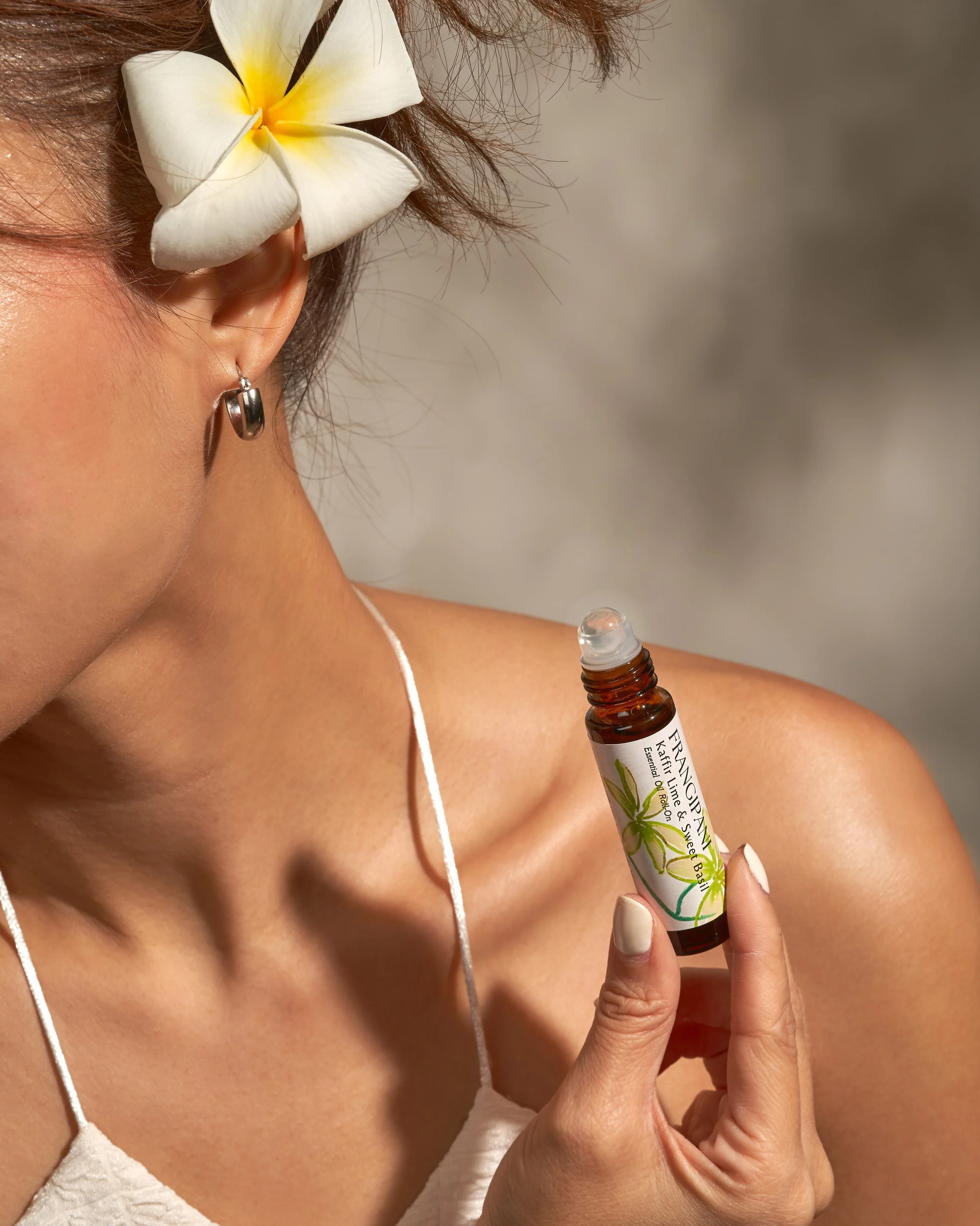
Similarly, the Kaffir Lime & Sweet Basil Essential Oil Roll-On brings together two bright, herbaceous notes that are deeply familiar in Southeast Asian aromatherapy traditions. Kaffir lime is sharp and alive; sweet basil adds a warm, herbal richness. Together, they create something that feels stimulating without being aggressive — energizing in a way that still feels grounded.
If you want to explore the full range of energy-supporting products, our For Energy collection brings together the individual oils and blends most suited to this purpose.
How to Use Essential Oils for Energy (Practically)
Knowing which oils to use is only half the equation. How you use them matters just as much.
Diffusing is the most common method and works well for sustained, ambient energy support — particularly good for work-from-home environments or morning routines. Add 5–8 drops of your chosen oil (or blend) to a diffuser with water and run it for 30–60 minute sessions. Peppermint, lemongrass, and eucalyptus all work beautifully this way.
Direct inhalation is faster and more portable. You can open a bottle and breathe deeply over it, or apply a small amount of diluted oil to your palms, cup them over your nose and mouth, and take three to five slow, deep breaths. This is particularly effective for an immediate boost.
Roll-ons on pulse points combine the convenience of direct inhalation with topical absorption. The warmth of pulse points (wrists, neck, temples) helps diffuse the scent continuously. Our pre-diluted roll-ons are designed specifically for this application method — no mixing, no measuring, just roll and breathe.
In the shower is an often-overlooked approach. A few drops of eucalyptus or peppermint oil on the shower floor (away from the drain) creates a natural steam inhalation that's incredibly effective for morning energy.
If you're new to all of this, the Essential Oils 101 guide on our site is a good place to start — it covers the basics of choosing, using, and caring for your oils in plain language.
Pairing Essential Oils With Your Daily Routine
Essential oils for energy tend to be most effective when anchored to a consistent daily ritual rather than reached for randomly. Here are some natural entry points:
Morning diffusing ritual: Start your diffuser before you make coffee. By the time you're sitting down to begin your day, the scent has already done some of its work.
Pre-workout: Peppermint specifically has been studied in the context of physical performance. Applying our peppermint oil diluted in a carrier oil to your temples and chest before exercise can enhance both mental readiness and perceived exertion. You might also find our Essential Oils for Workout guide useful here.
The 3pm reset: Keep a roll-on at your desk. When the afternoon slump hits, apply it to your wrists, breathe deeply, and spend two minutes away from your screen. The combination of scent and micro-break is more effective than either alone.
Study sessions: Citrus and herbaceous oils have been associated with improved focus and retention. For more on this, our Essential Oils for Study guide goes deeper into oils and application methods suited to cognitive work.
A Note on Quality
One thing worth saying clearly: not all essential oils work the same way, because not all essential oils are the same thing. The market is full of synthetic fragrance oils sold as essential oils, or diluted products with minimal active botanical content. These may smell pleasant, but they're not doing the same neurochemical work as a genuinely pure, plant-derived oil.
At Frangipani, every product is 100% plant-derived, paraben-free, phthalate-free, cruelty-free, and vegan. We don't use synthetic additives or artificial preservatives. When you're building a daily ritual around these oils, that purity isn't a luxury detail — it's what makes the ritual actually work.
Frequently Asked Questions
Do essential oils actually increase energy, or is it just the scent that's pleasant? The effect is more than just pleasant smell. Certain aromatic compounds — particularly menthol in peppermint and 1,8-cineole in eucalyptus — interact with olfactory and trigeminal receptors in ways that have measurable effects on alertness, cognitive performance, and even physical output. The experience is real, even if it's more subtle than caffeine.
Which essential oil is best for fighting the mid-afternoon slump? Peppermint is the fastest-acting, and the Litsea Cubeba & Bergamot Roll-On is specifically formulated for this kind of moment — quick to apply at your desk, with a scent that genuinely lifts mood and clears mental fog.
Can I use essential oils for energy every day? Yes, for most people daily use is fine, especially with inhalation methods. For topical application, use oils diluted in a carrier oil and give your skin occasional breaks if you notice any sensitivity.
What's the best essential oil for energy in the morning? Eucalyptus or peppermint in a diffuser or shower steam is ideal for mornings — both are fast-acting, respiratory-opening, and great for transitioning out of sleep. Lemongrass and bergamot are also excellent morning oils if you want something a little warmer and mood-lifting alongside the alertness boost.
Are essential oils safe to use before exercise? Generally yes. Peppermint in particular has been studied specifically in athletic contexts with positive results. Always ensure topical applications are properly diluted (2–3% in a carrier oil) and do a patch test if you have sensitive skin.
What's the difference between a diffuser oil and a roll-on for energy? A diffuser creates an ambient aromatic environment over a longer period — good for sustained work sessions or morning routines. A roll-on is more immediate and portable, applied directly to pulse points for a quicker, more targeted effect. Both work well; the best choice depends on your lifestyle and where you most need the support.
Can essential oils replace caffeine? They're a different kind of tool rather than a direct substitute. Essential oils don't contain stimulants in the way caffeine does, but for many people — particularly those sensitive to caffeine or looking to reduce their intake — building a consistent aromatherapy ritual provides meaningful energy and focus support without the crash.
Explore the full For Energy collection at Frangipani, or browse our Essential Oils 101 resources to learn more about choosing and using oils that are right for you.